


When 300 km/h feels isolating
High-speed rail is known for speed, connectivity, and sustainability. Yet academic research keeps finding a blind spot: passengers’ subjective well-being suffers from small friction points (broken seats, quiet-coach disruptions, unexpected delay cascades) that usually go unrecorded.
Why academic surveys fail passengers
Traditional academic surveys are long, abstract, and sent hours or days after the trip. Fatigued passengers drop out before finishing, and those who had the most frustrating trips simply delete the email. So the feedback that could improve rail service the most is the first to be lost.
Insight
The Dual Design Challenge
A paper questionnaire dropped onto a mobile screen will not capture accurate well-being data. Two problems need solving at once: cut the cognitive effort of responding to nearly zero, and give passengers real help in return, so that sharing how they feel is worth their time rather than unpaid data work.
Where thesis research meets daily utility
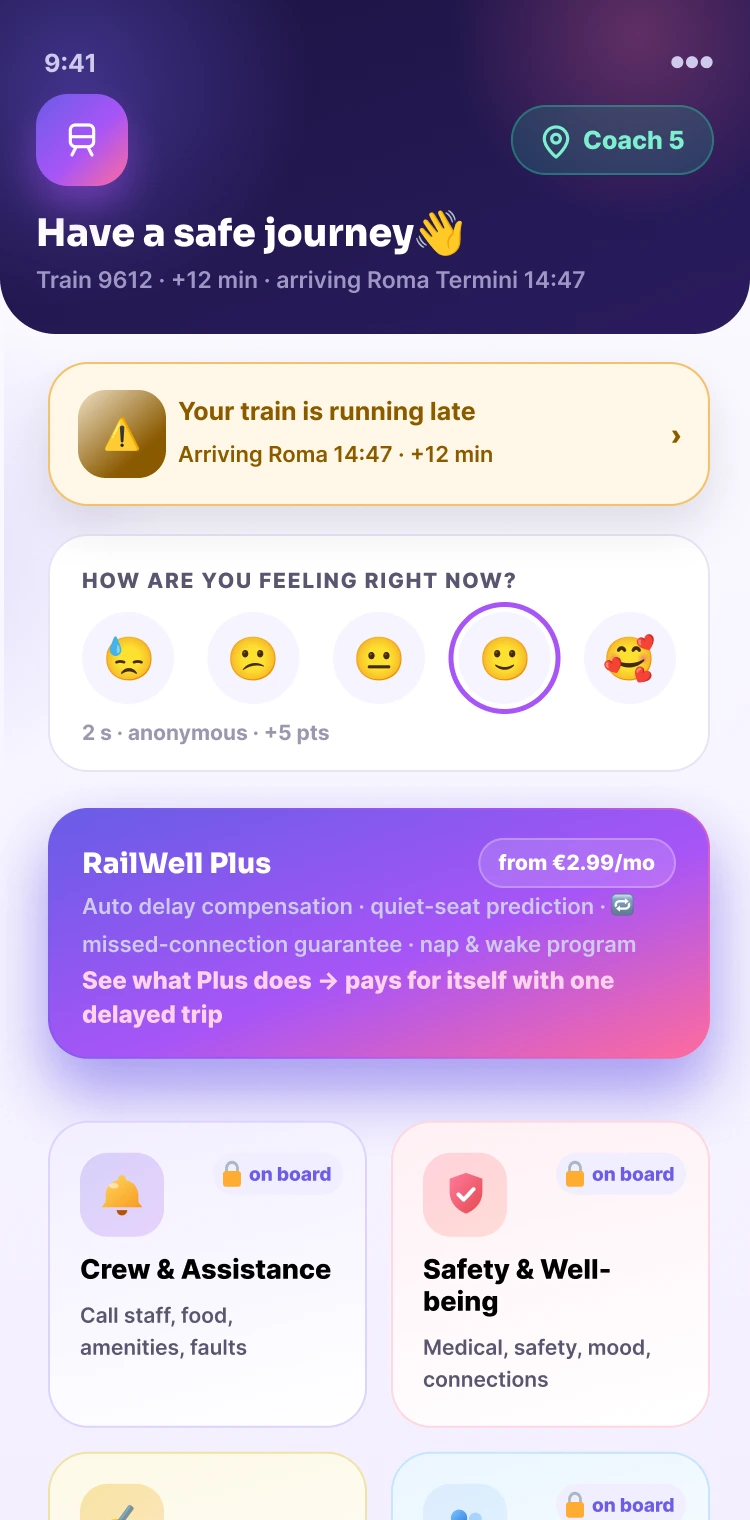
Instead of opening on a questionnaire, RailWell starts with the passenger’s journey as it is happening. Live delay alerts and quick crew access earn the user’s trust before the app asks for their time.
- Contextual Trip Awareness: The live delay banner (“+12 min · arriving Roma Termini 14:47”) proves the system knows what is happening, framing mood questions in context.
- Dissolved Micro-Survey: “How are you feeling right now?” requires a single emoji tap: 2 seconds, completely anonymous, and rewarded with points.
- Safety & Crew One-Tap Lines: Direct buttons for onboard crew, safety assistance, and an SOS trigger ensure the app prioritizes passenger care over data gathering.
- Reciprocal Value (RailWell Plus): Automatic delay compensation guarantee and onboard perks demonstrate that the rail operator gives back in exchange for passenger insights.
From Academic Theory to Quick Micro-Interactions
How the research translates validated psychological scales (PANAS & Subjective Well-Being indices) into mobile touchpoints travellers actually enjoy.
Deconstruct Academic Scales
Stripping away dense academic jargon and converting multi-paragraph questions into single-sentence first-person statements.
In-Moment Triggering
Capturing emotional states mid-transit when friction occurs, rather than relying on flawed post-trip memory recall.
Two-Way Reciprocity
Providing passengers with immediate fault tracking and reassurance so reporting feels like taking action, not doing homework.
Ethical & Transparent Consent
Clearly separating operational feedback from academic research consent with a single, transparent opt-in toggle.
Empowerment through rapid reporting
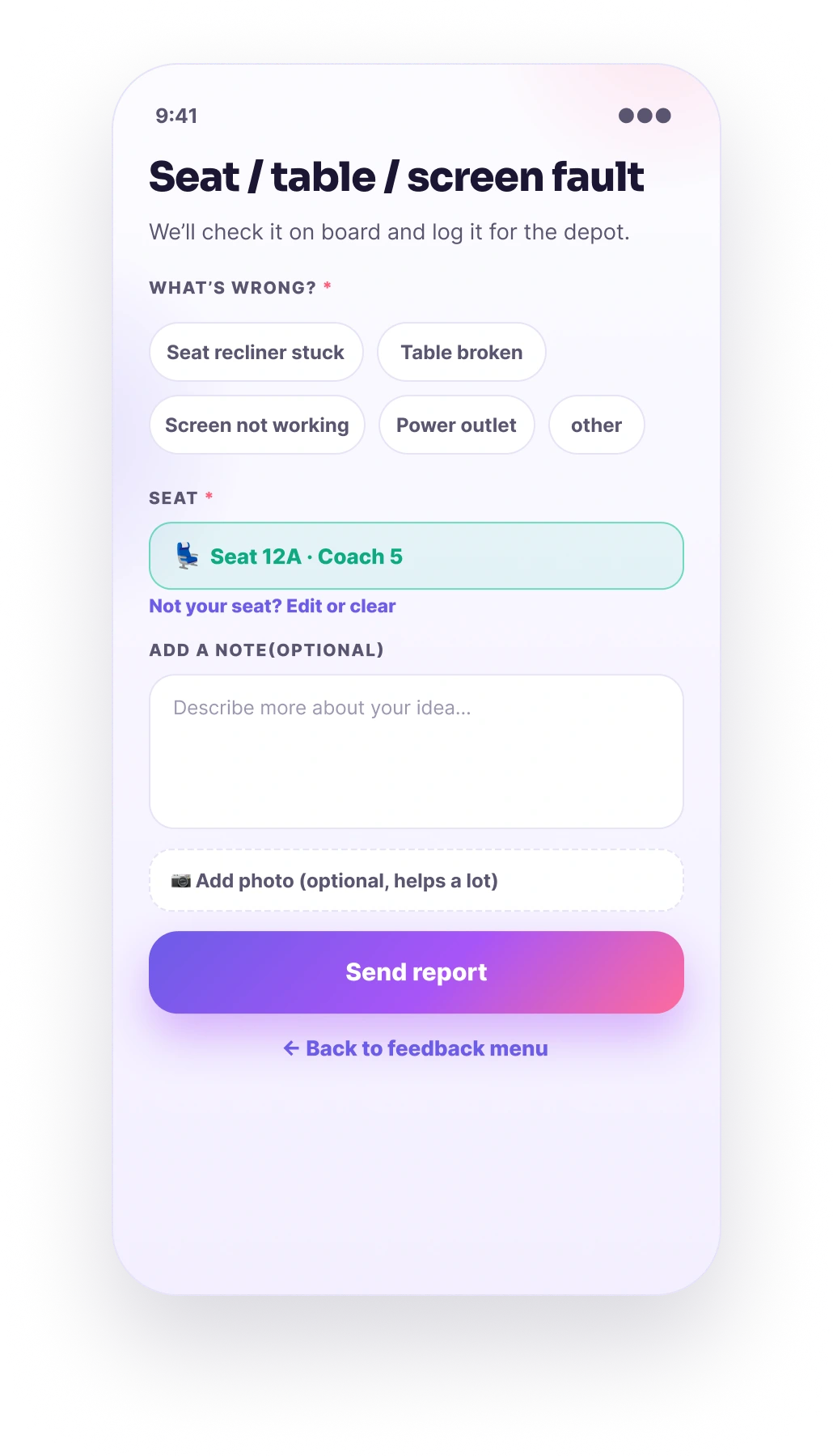
When passengers encounter a seat malfunction or noisy disturbance, RailWell enables a 2-tap fault report pre-filled with their seat and coach number. There are no lengthy drop-down menus or mandatory text fields.
Making “We are listening” visible
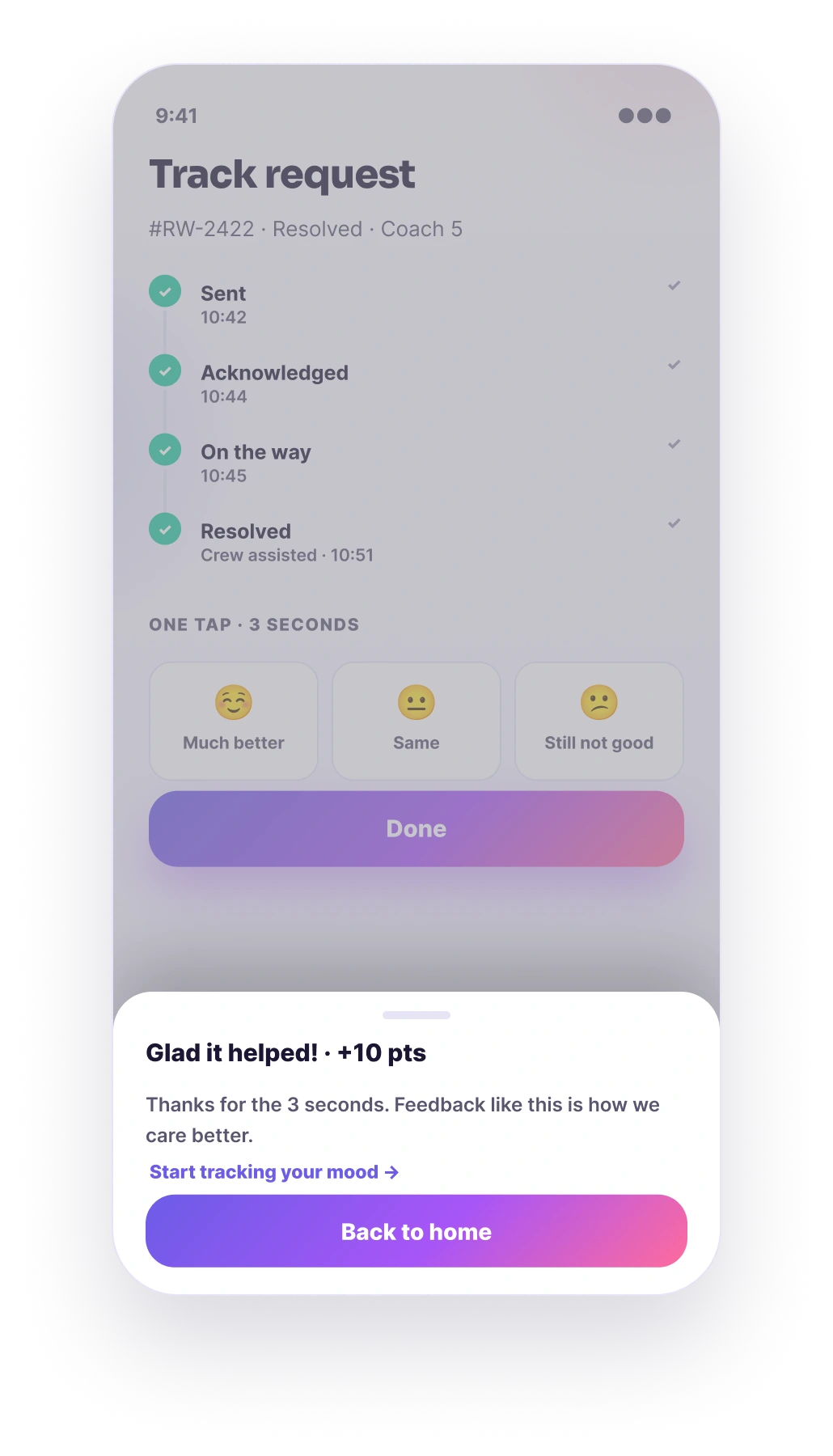
The most reassuring part of RailWell is the live status timeline. Once a report is submitted, the passenger watches it move from Sent to Acknowledged to On the way to Resolved in under four minutes.
The survey flow: ten seconds, one screen
The survey screen boils complex academic Likert scales down to an approachable interface that can be completed without scrolling or mental strain.
- Feelings First: An immediate 5-emoji emotional temperature check captures 80% of the analytical value in under 2 seconds.
- Contextual Cause Chips: Tappable pills (Comfort, Quiet, Speed, Crew, Cleanliness) allow passengers to explain why without typing.
- Accessible 1–5 Rating Scales: Plain-language statements such as “I feel relaxed right now” replace ambiguous metric grids.
- Transparent Privacy: An explicit checkbox guarantees passenger data remains anonymous and strictly bounded to university research.
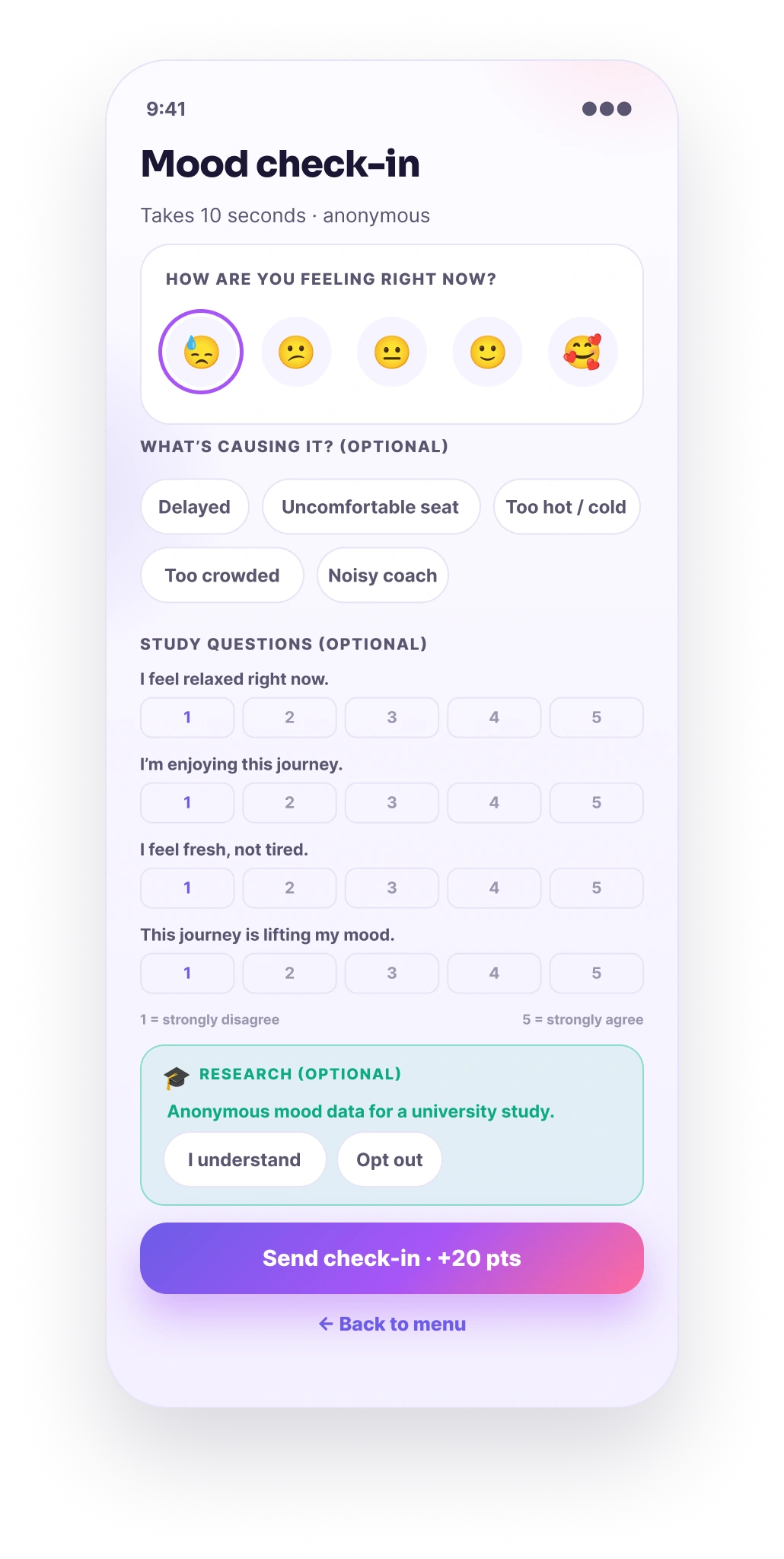
Projected 3.5× higher completion rate compared to standard post-trip email surveys by capturing sentiment in-moment.
Provides railway operators and academic researchers with immediate, geo-tagged mood data across line corridors.
Replaces waiting helplessly during delays with active communication channels and guaranteed resolution tracking.
Upcoming empirical evaluation with passengers traveling along the Naples–Rome high-speed corridor (Frecciarossa & Italo lines).